

Three seconds to take a picture
Article topic: Technology and Autonomy
In one of my tests of a text recognition application, what struck me most happened before I started reading. First, I had to photograph the document.
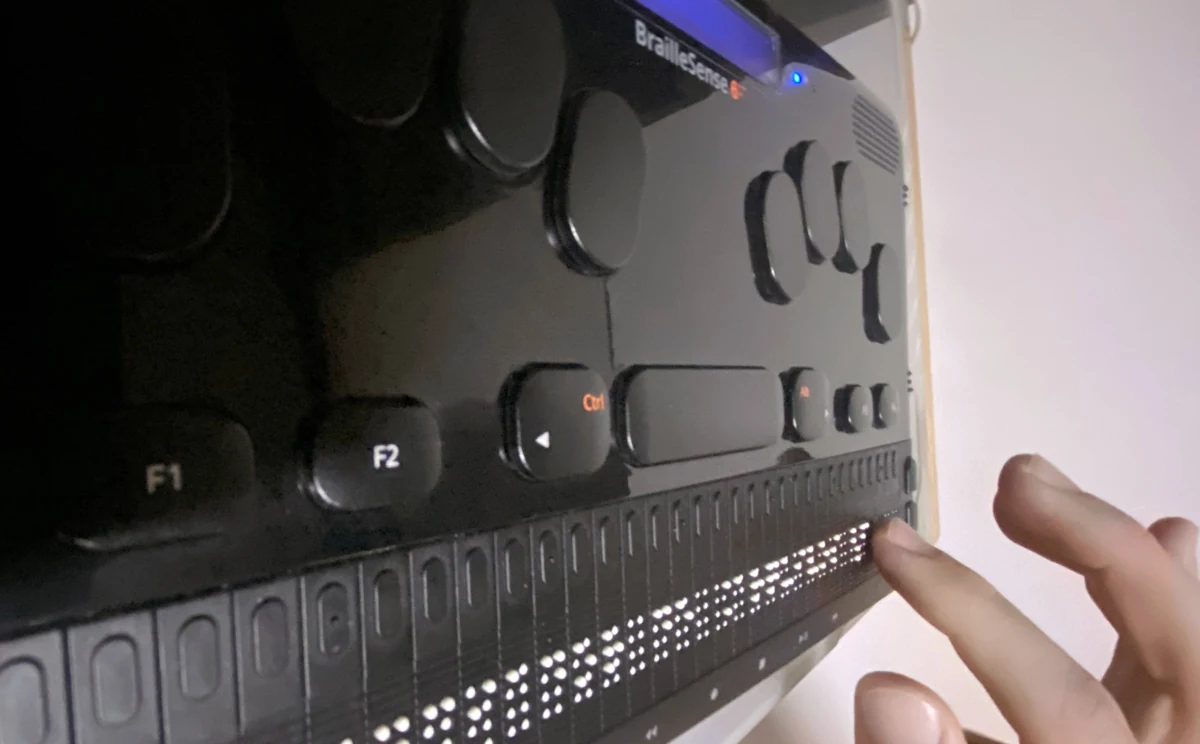
The application was installed on a device with a keyboard and a braille display. I could move through its options with physical buttons, and every element I tested was clearly labeled. Once the image had been captured, reading was quick: I could listen to the document with text-to-speech or read it with my fingers. I could also save the file and open it again.
The trouble came when I took the picture. About three seconds passed between the moment I pressed the button and the capture. The experience was different from the one I had with my phone. I had no way of knowing whether the delay came from the hardware, and I said so in the evaluation I sent to the development team. I also suggested offering some kind of stand to hold the device steady while the picture was being taken.
To photograph a page, I have to keep the camera in the right position relative to the paper. If the device moves during the capture, I may have to do it again. The quality of the recognized text also depends on those seconds when I’m still holding the device. I cared as much about the reading as about the way to get there.
What am I going to use it for?
Some time before, someone had asked me about another portable reader. I said I thought it was suitable for single documents, such as finding the amount due on a bill, and that I didn’t necessarily see it as a replacement for a device designed for other kinds of reading. Optical character recognition was useful in both cases, but the tasks were different.
Something similar happened with other products. I remember reviewing a navigation aid that used a sensor to warn of obstacles. I was concerned about the position in which the hand had to be held and, above all, about what information I would have to decide which way to move. Knowing there’s something in front of you isn’t the same as knowing what it is or how to get around it. It wasn’t an experimental assessment of every sensor of that kind; it was my objection to that particular way of using them.
When I’m asked to evaluate an assistive device, I prefer to start with the task someone wants to do. If it’s reading a bill, what I want is to find the amount due. For that, it matters as much to me that the application recognizes the words as that I can take a usable picture myself, without asking someone else to take it for me. With that application, each picture meant about three seconds of waiting with the device in my hand.